
One New Year’s Eve a few years back, a friend hosted a small cocktail party where one of his angel investors happened to be present. At some point the conversation turned to a previous venture of his and how he’d staffed his teams. He laid out a “Five Elements” theory: a company is composed of metal, wood, water, fire, and earth, and you should match team types to cities based on their elemental affinity. Hangzhou belongs to wood, so it’s a good fit for the operations team; Shenzhen belongs to fire, so it’s better for the marketing team… and so on. Apparently the venture worked out in the end.
Personally, I think it has less to do with elemental mysticism and more to do with the talent profile of each city. Hangzhou genuinely has great operations talent — after all, it’s the heart of China’s e-commerce industry. Cities like Shenzhen and Dongguan have a strong service-industry culture; the principle that “money is proportional to effort” is deeply ingrained there, so salespeople naturally hustle.
Whether my guess is right or not, I can’t say — I haven’t lived in those cities. Putting the superstition aside, though, I do find the Five Elements framework useful as a lens for evaluating companies. I happened to read a similar article yesterday morning, so I figured I’d jot this down as a note.
The Five Elements of a Company
As I remember it, that night’s framework broke down into the following — covering both internal and external factors. I’ve often used these five angles when looking at companies since:
- Earth: the soil — the industry
- Wood: methodology, the boss
- Water: water flows — the company’s resources
- Fire: the team — a great team has to burn with passion
- Metal: finance — the financial situation
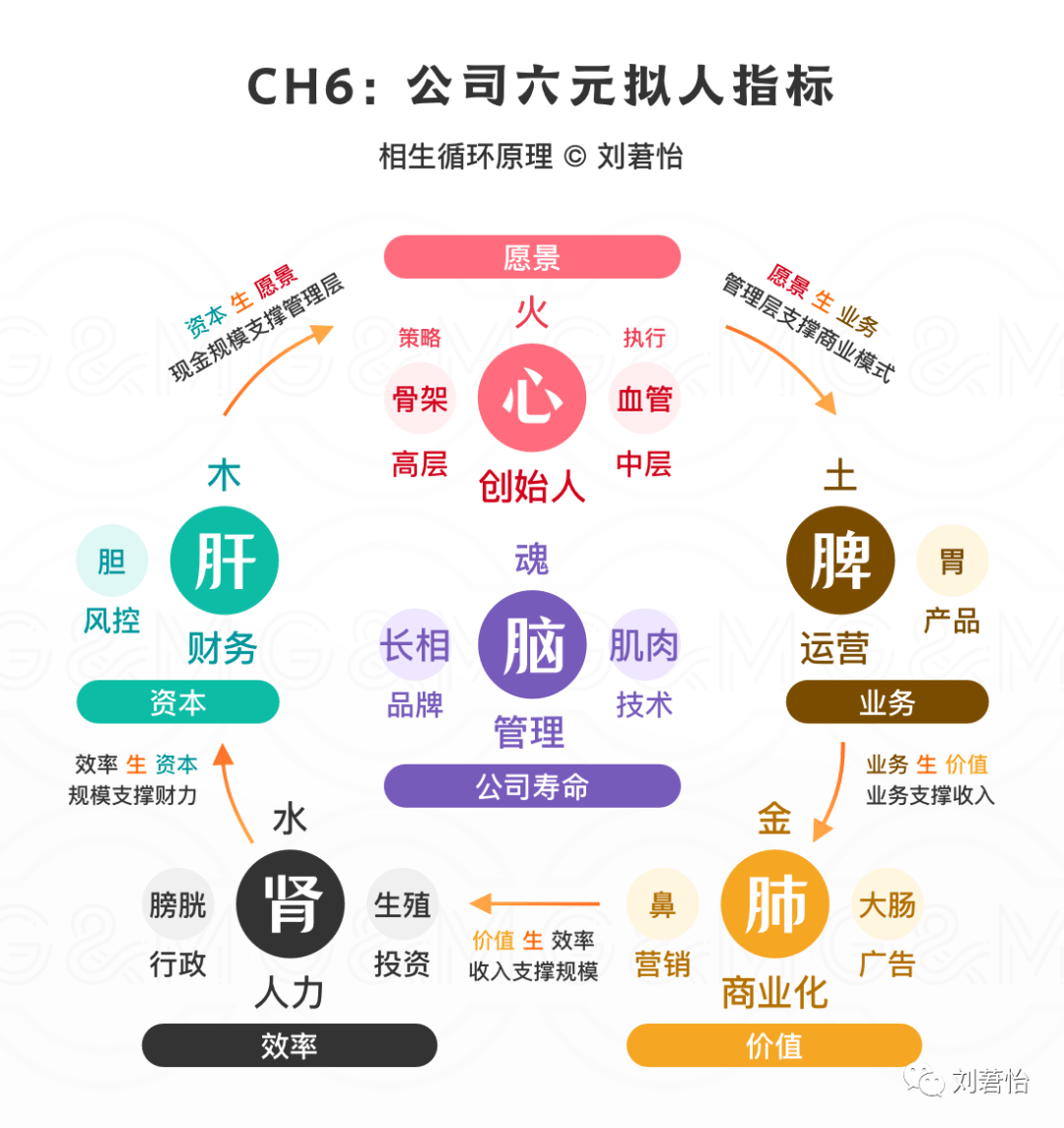
Six-Element Organizational Metrics for Personification
Yesterday I came across this article: Without KPIs or OKRs, How Do Early-Stage Startups Set Metrics? Try ×6.
It introduces a “Six-Element” framework for the company itself, breaking down the organization’s internal ecosystem. I thought it was an interesting model — putting it here as a note for myself.
Comments