
I’ve been working on some lottery-style campaigns recently, and a colleague shared this article with me. I’m reposting it on my blog as a personal reference. The article explains lottery-style campaigns, breaks down gameplay design and UI patterns, and there are a few of my own annotations at the end.
1. Overview
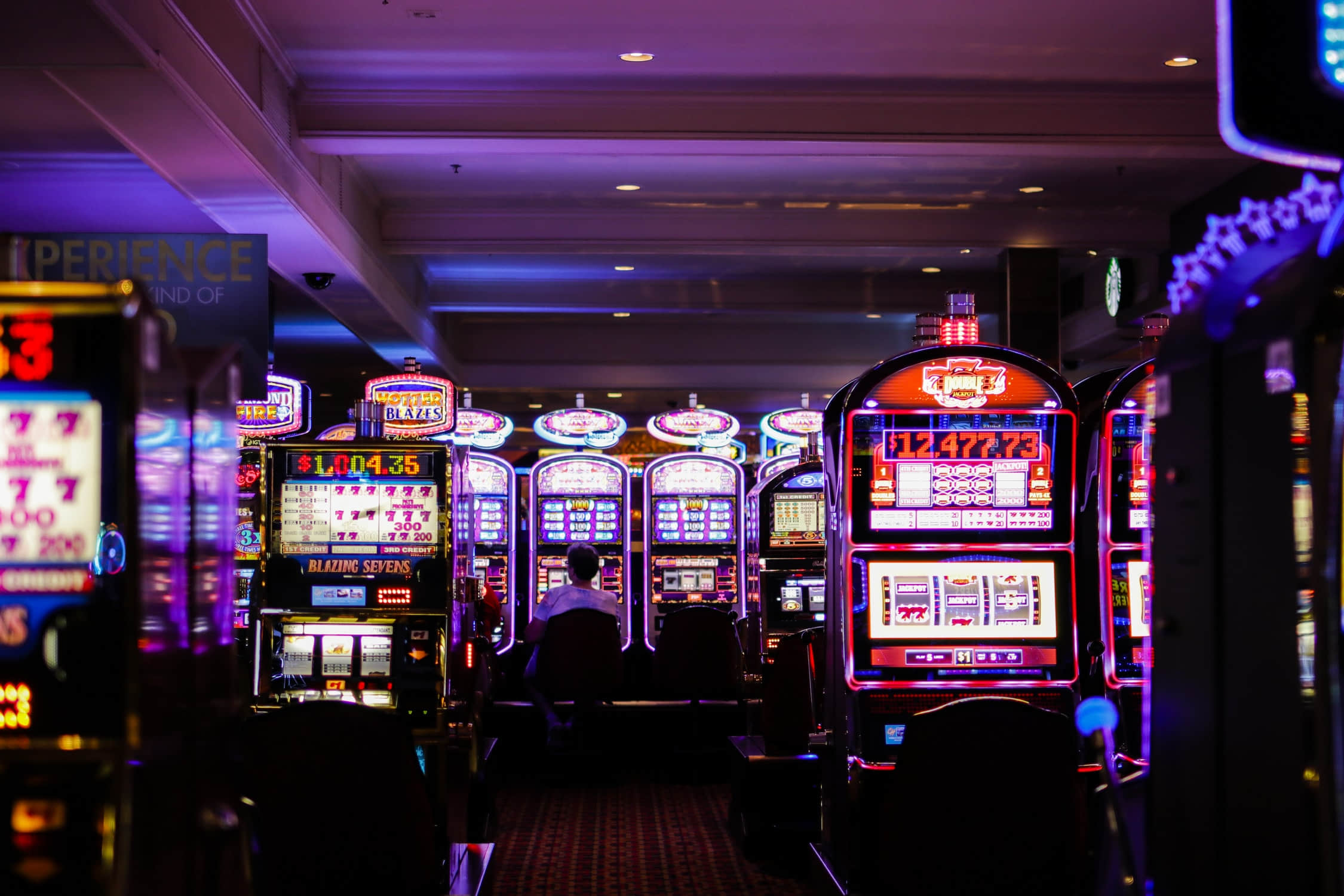
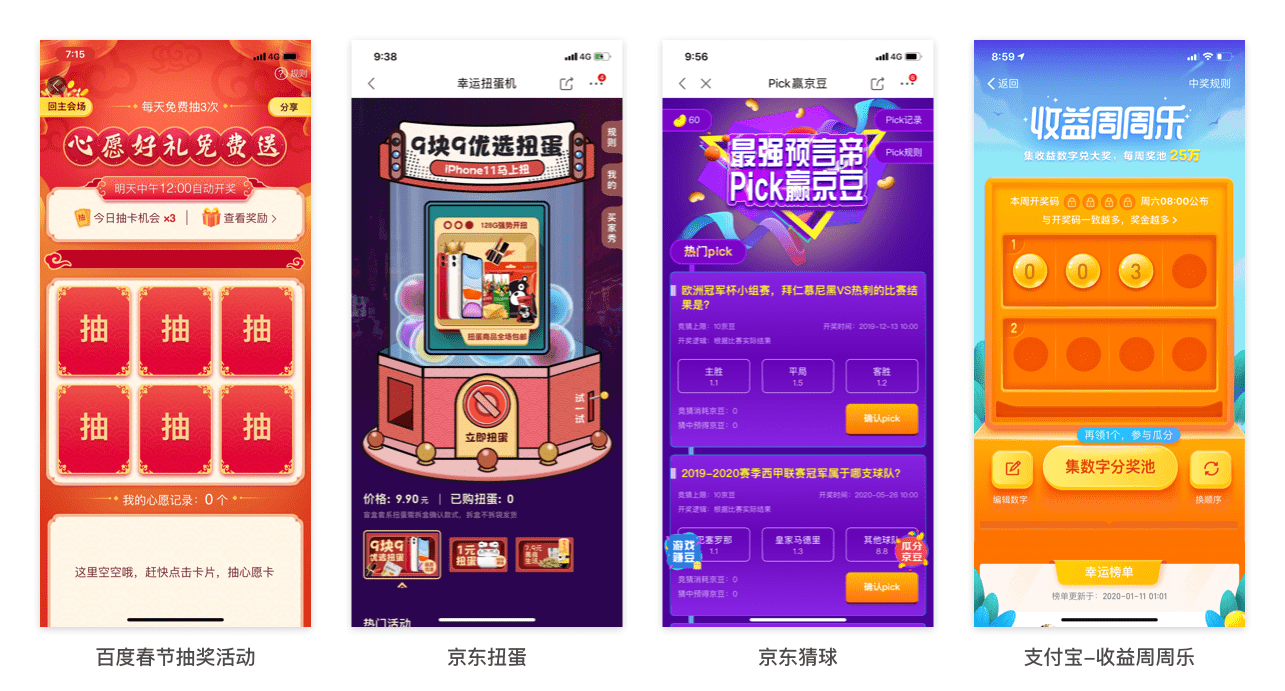
Campaigns with a “gambling” flavor are almost always a first choice in operations playbooks. They tend to mimic offline gambling scenarios — wheels of fortune, gachapon machines, slot machines, shell games, card flips, red-envelope rain, lottery tickets, etc. — and turn them into interactive visuals. With a simple action (usually a tap), the user randomly receives coupons, rebate vouchers, small cash rewards, and the like. Business conversion typically happens in two phases: when the user earns lottery chances and uses the prizes they win.
These campaigns have strong narrative pull. Humans are wired to be fascinated by gambling games and are willing to try them. Executed well, they succeed easily. But notice: compared to real-world gambling, the mobile environment is weak at creating atmosphere, the prizes are usually low-value items like coupons, and it’s hard for users to feel the visceral thrill of “almost winning” and “random rewards” that real gambling delivers. If users get repeatedly disappointed, they’ll start to feel cheated and bored, and churn out before any business conversion happens.
By draw cycle, gambling-style games can be split into instant draws and periodic draws. The longer the cycle, the higher the churn.
2. Gameplay Design
The primary driver behind participation in “gambling-style” campaigns is curiosity about the unknown. We’re collectively obsessed with unpredictable experiences and crave exploration. To satisfy our curiosity, we’re willing to act immediately. This is a fundamental survival and evolutionary mechanism — and the gambling industry has exploited this “human weakness” to stay perpetually relevant.
Of course, there’s more at play psychologically: loss aversion, sunk-cost avoidance, and so on. But this is enough to explain why these campaigns work.
In the user’s journey, curiosity, the lure of big prizes, or social pressure initially pulls them in. They take the designed action to win prizes. Because of the random reward + instant feedback mechanic, dopamine fires and the user feels pleasure — they get hooked, and the campaign succeeds.
The catch: prize design in these campaigns is usually extremely homogeneous — coupons, discount vouchers, more coupons. After a few draws, users get bored and stop feeling excitement. On top of that, these campaigns often require users to complete tasks to earn draw chances. Users invest effort but don’t feel the rewards are “equivalent,” so they feel cheated and leave.
So when designing, first build the “gambling” atmosphere — use big-prize displays, live activity feeds, and a lively audio-visual presentation. Second, combine other behavioral motivators, extend the gameplay, and adapt to the user’s shifting motivations — to maximize the incentive effect and drive behavior.
2.1 Give Users Free Trial Chances
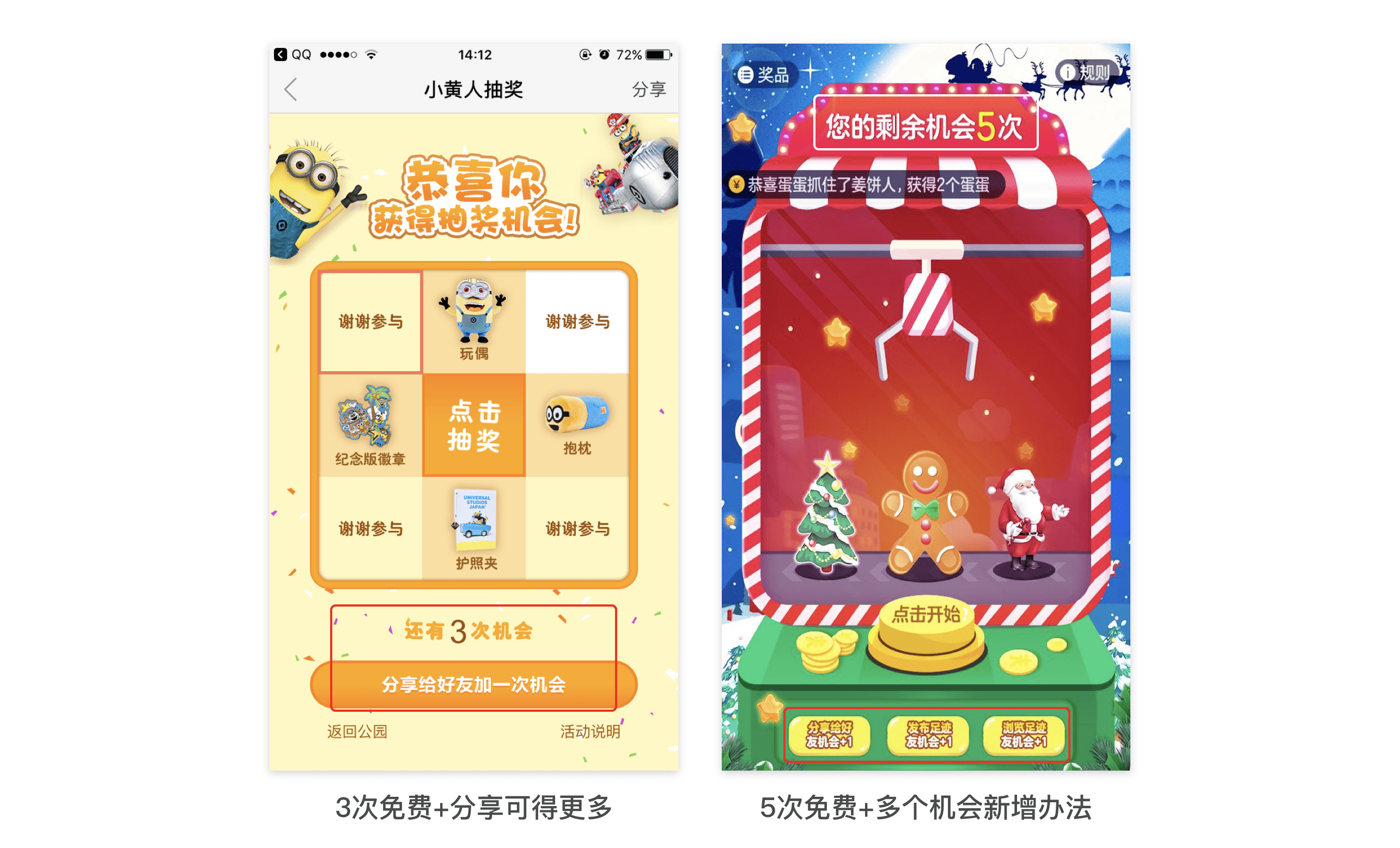
Provide some free trial chances at the start to ease users into the campaign, while doing onboarding and behavioral conditioning. Two or three free draws is about right — too few or too many both work poorly. Free chances usually refresh daily (or not at all); once used up, users earn more by completing conversion-related tasks.
2.2 Strategize the User’s Winning Path
Each prize feels random to the user — “fair, transparent, no inside game.” But to optimize the metrics that matter (participation / conversion / virality), the winning path has to be deliberately designed. Once you balance operational cost, business goals, and user experience strategically, the result far outperforms naive randomness.
2.2.1 Prize and User Tiering
Designers tier the target user base and the available prize pool. The point is to achieve optimal prize-user matching and lift conversion.
User tiers are usually based on user attributes — new vs. returning, power users, etc. — or behavioral preferences (“daily-essentials shoppers,” “personal-care shoppers,” and so on).
Prize tiering happens along two dimensions: how often each tier of user wins each prize, and how attractive (i.e., valuable) each prize is to users in that tier. When matching users to prizes during a draw, you mix in some randomness to create a “random-feeling” but high-hit-rate winning path.
2.2.2 Strategize Prize Distribution
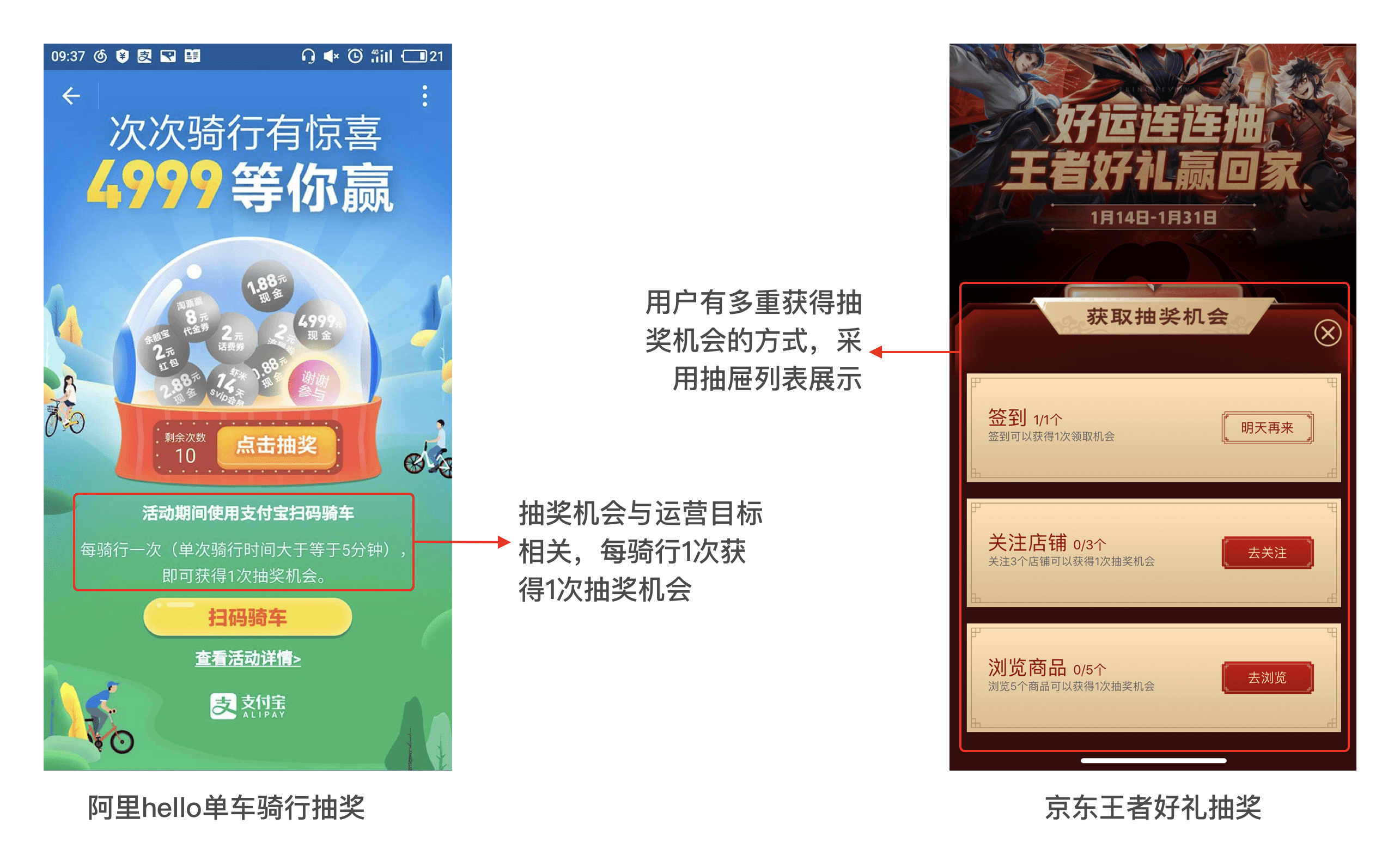
In the free phase, the typical prizes are coupons and discount vouchers — low value. This easily creates the perception that the campaign isn’t worth much and that there’s nothing to lose by skipping it, which hurts retention into the conversion phase.
A better move: when the user’s free chances run out for the first time, hand out a more attractive prize — say, a small cash red envelope — tailored to the user’s tier from the previous step. This sets the expectation that the campaign is valuable and that subsequent task-completed prizes will also be substantial, smoothly bridging the user into the conversion phase.
During the conversion phase, users invest time, money, and emotion to earn more draws. They expect more. Repeatedly receiving low-value prizes will churn them. This is where prize tiering pays off — dispense progressively more attractive prizes based on the user’s tier, with some randomness — maximizing the conversion depth (the number and difficulty of tasks completed).
You can also set up prize reset strategies — e.g., reset the wheel prizes daily, or after a big-prize round. The reset mechanic introduces scarcity through time pressure, raising user motivation. With a rich enough prize pool, you can even let users pick from a group of potential prizes.
2.2.3 How Draw Chances Increase
The standard pattern: the system gives free draw chances; once exhausted, they recover one or more times after a countdown (a scarcity mechanic). In parallel, the system offers an alternative path — complete a task to earn more draws. Task push should account for both business goals and user attributes, ideally tiered like users and prizes are, controlling completion rates by personalizing the task list. This lifts both completion rate and conversion.
Whether to offer a recovery mechanic at all depends on whether the campaign cares about repeat visits and whether the prize budget can sustain it. Most campaigns want users to visit as often as possible to maximize impact, so recovery is usually worthwhile. There are exceptions — for instance, Alipay ran a one-time campaign to push unrated users to take its risk-assessment, where completing the assessment earned a single wheel spin, and that was that.
PS: Don’t undermine the campaign’s basic structure with special tasks (e.g., “complete task X to guaranteed-win prize Y”). That kind of design feels too aggressive and will turn users away.
2.3 Higher-Order Motivation — Sense of Mission
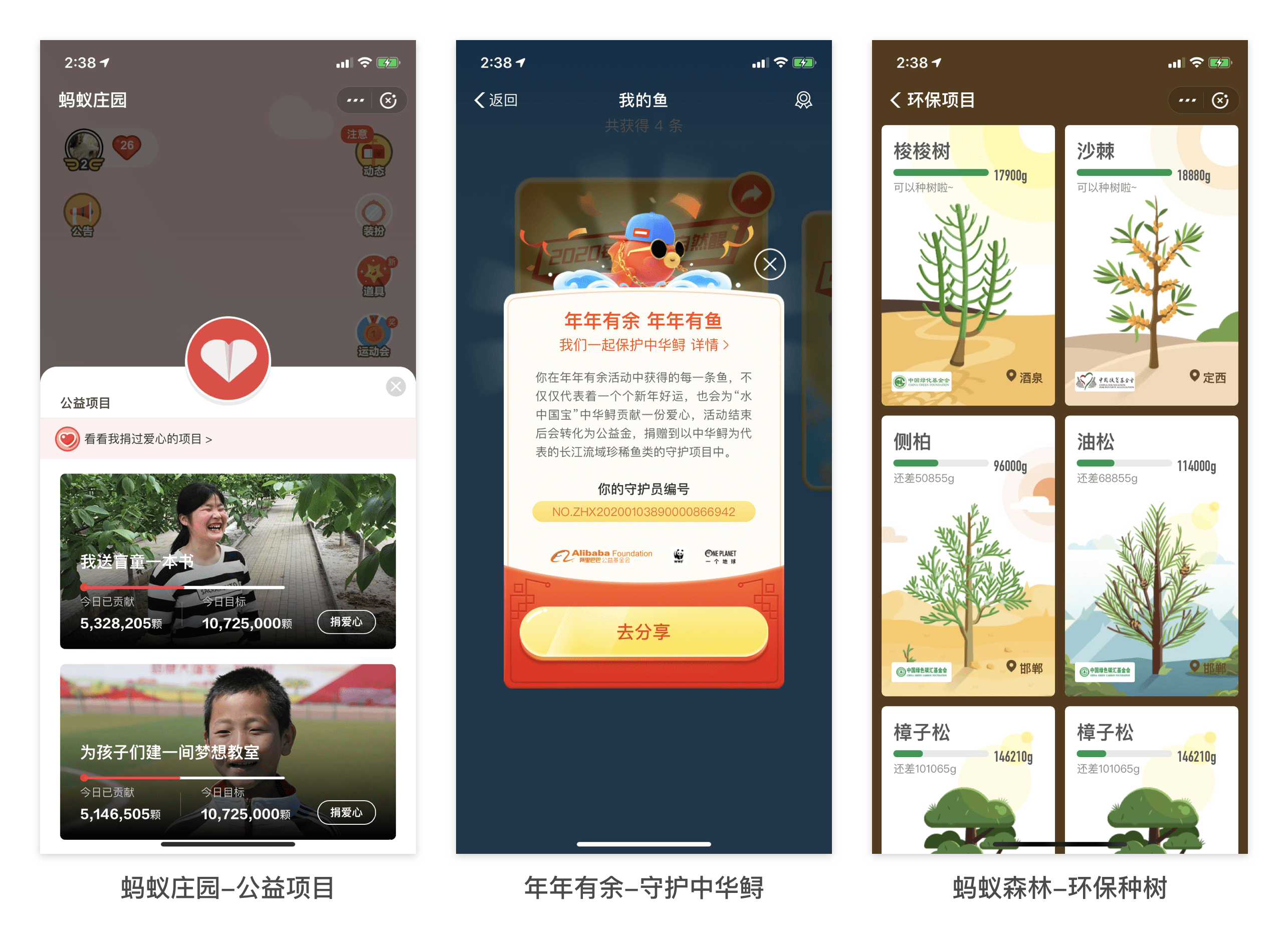
In Maslow’s hierarchy, sense of mission sits between Esteem (level 4) and Self-Actualization (level 5) — a high-order need. If a campaign can be tied to a sense of mission, it gives users much stronger behavioral motivation.
Think about what lottery players say when they don’t win: “I’m contributing to charity!” That larger-meaning narrative consoles them about their losses and gives them an “excuse” to buy more tickets. In China, charity is even the legal basis for the lottery industry to exist.
The catch is credibility and urgency — mission-based messaging is hard to make believable and lacks time pressure, so designers need to add other levers to compensate.
For credibility: partner with charities, and reinforce through storytelling (animation, etc.), exclusive badges (charity-specific badges), elite collectives (charity groups), leaderboards, and achievements (heroism). For urgency: introduce scarcity (limited badge quantities, limited participation windows).
Alipay has mastered this technique — Ant Forest, Ant Manor, Year of Abundance (protecting the Chinese sturgeon together) all carry traces of mission-driven design.
2.4 Show the Prizes
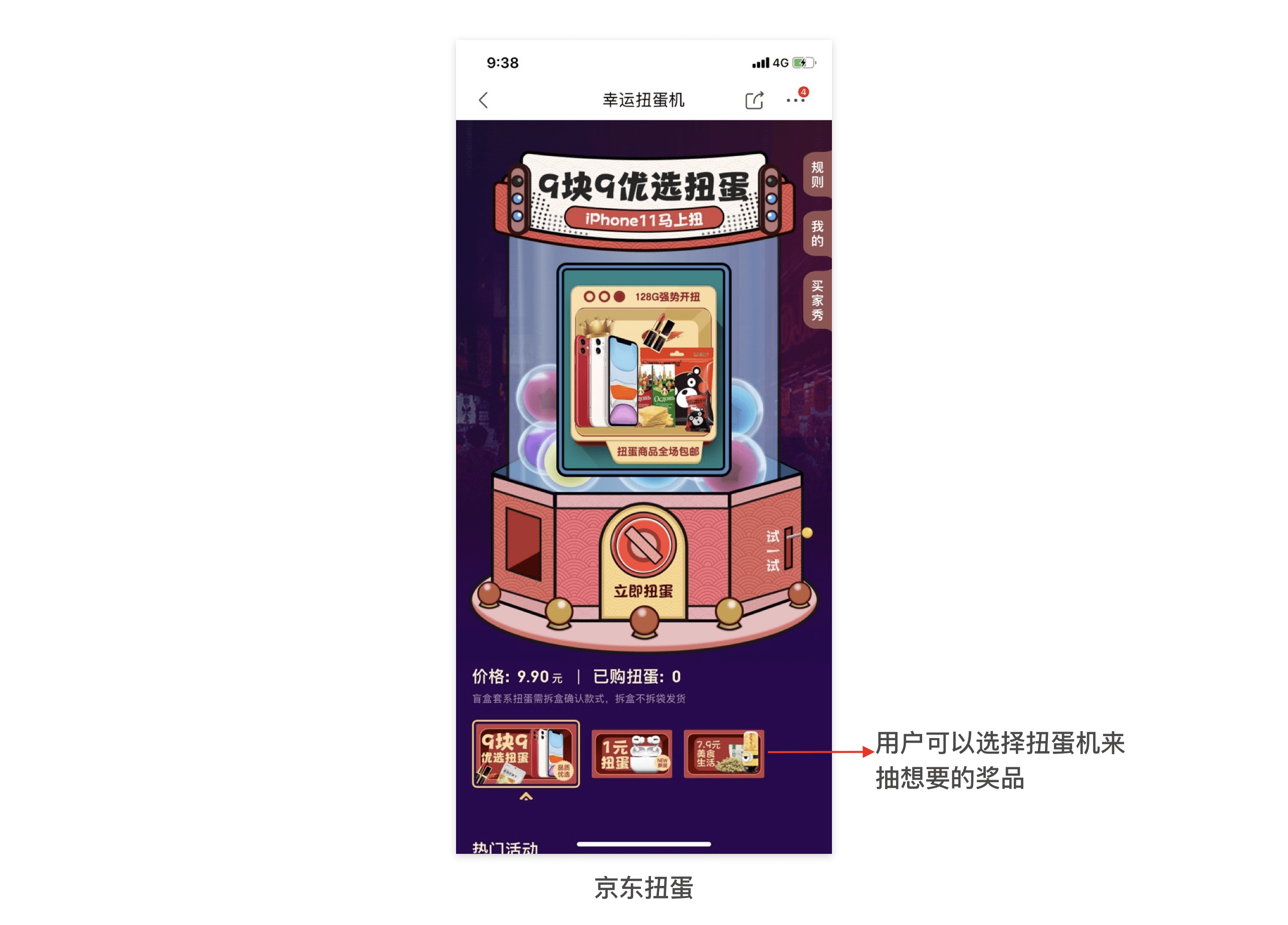
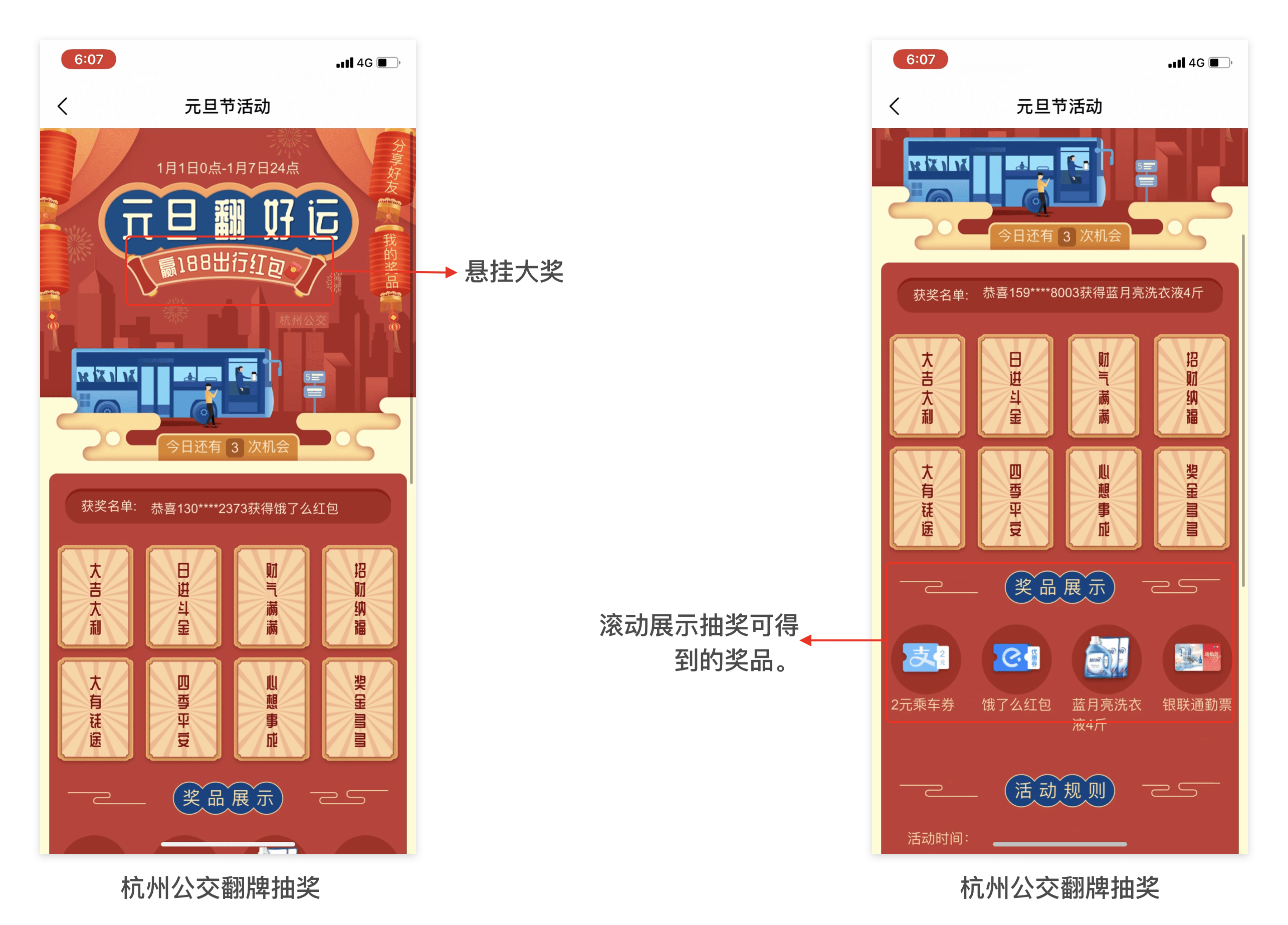
Random rewards don’t mean the prizes have to stay hidden. Display the most attractive prizes prominently, and hint at more. If possible, offer choice or personalization — this is especially valuable for long-running lottery campaigns.
The benefits: it triggers the user’s sense of ownership and acquisition, the dopamine anticipation effect, and wishful thinking — pushing them to act immediately.
“Dopamine anticipation effect” — even just expecting to obtain something or achieve something causes the brain to release dopamine, producing pleasure and strengthening the motivation to pursue it.
“Wishful thinking” — people always believe they’re the lucky one. Even with a slim chance, people are willing to take a small risk for a big reward instead of settling for a safe, middling one.
“In our evolutionary history there was no prepared event, no knowledge structure to help us seize the opportunity.” — Robert Williams
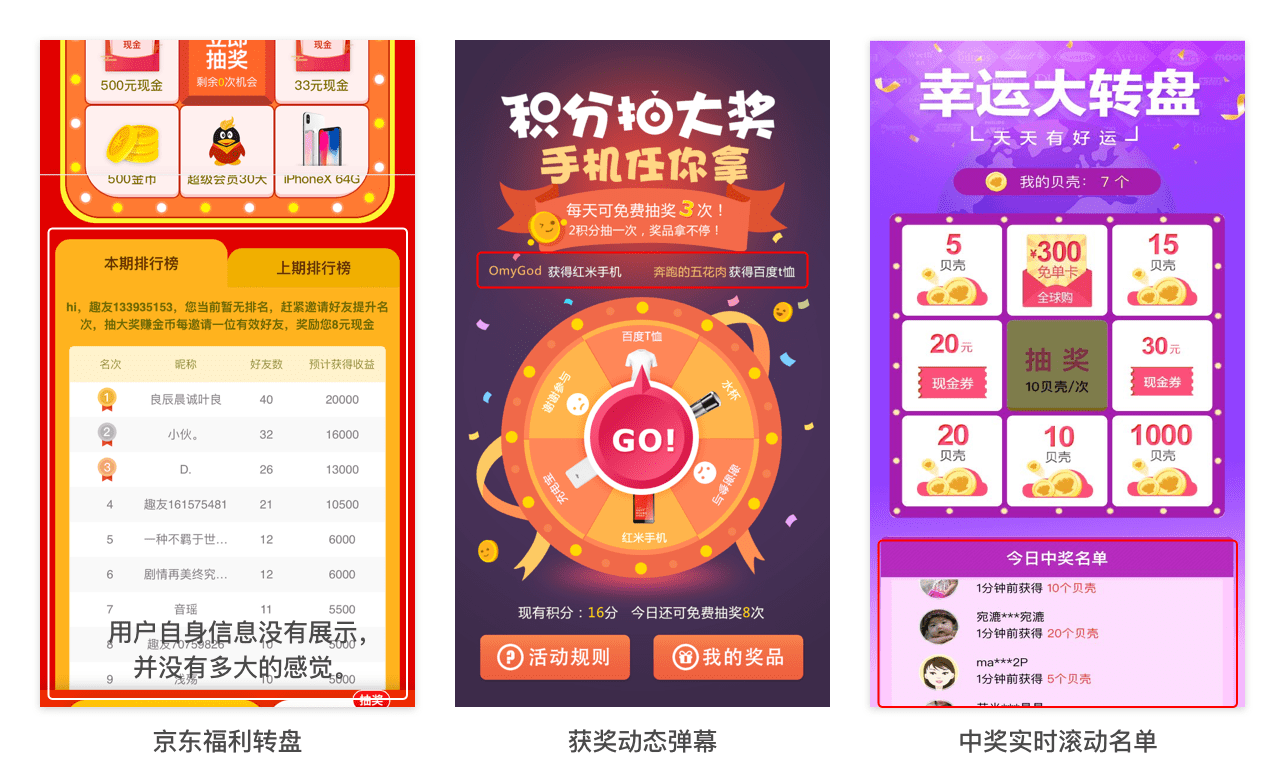
In practice, try the big-prize-on-display technique: showcase the top prize on the campaign page, dopamine kicks in, wishful thinking kicks in — “These could all be mine!” — and the user takes action. You can also run a scrolling live-win feed to reinforce wishful thinking and trigger the bandwagon effect. Avatars and names add credibility — especially avatars.
2.5 Give Users a Goal
As we noted, prizes that users win in a lottery campaign are the result of a strategized “randomness.” Random rewards, with their uncertainty, create more delight, pleasure, and achievement than fixed rewards — but uncertainty also means a lack of control. After several misses, users feel cheated and bored, and leave.
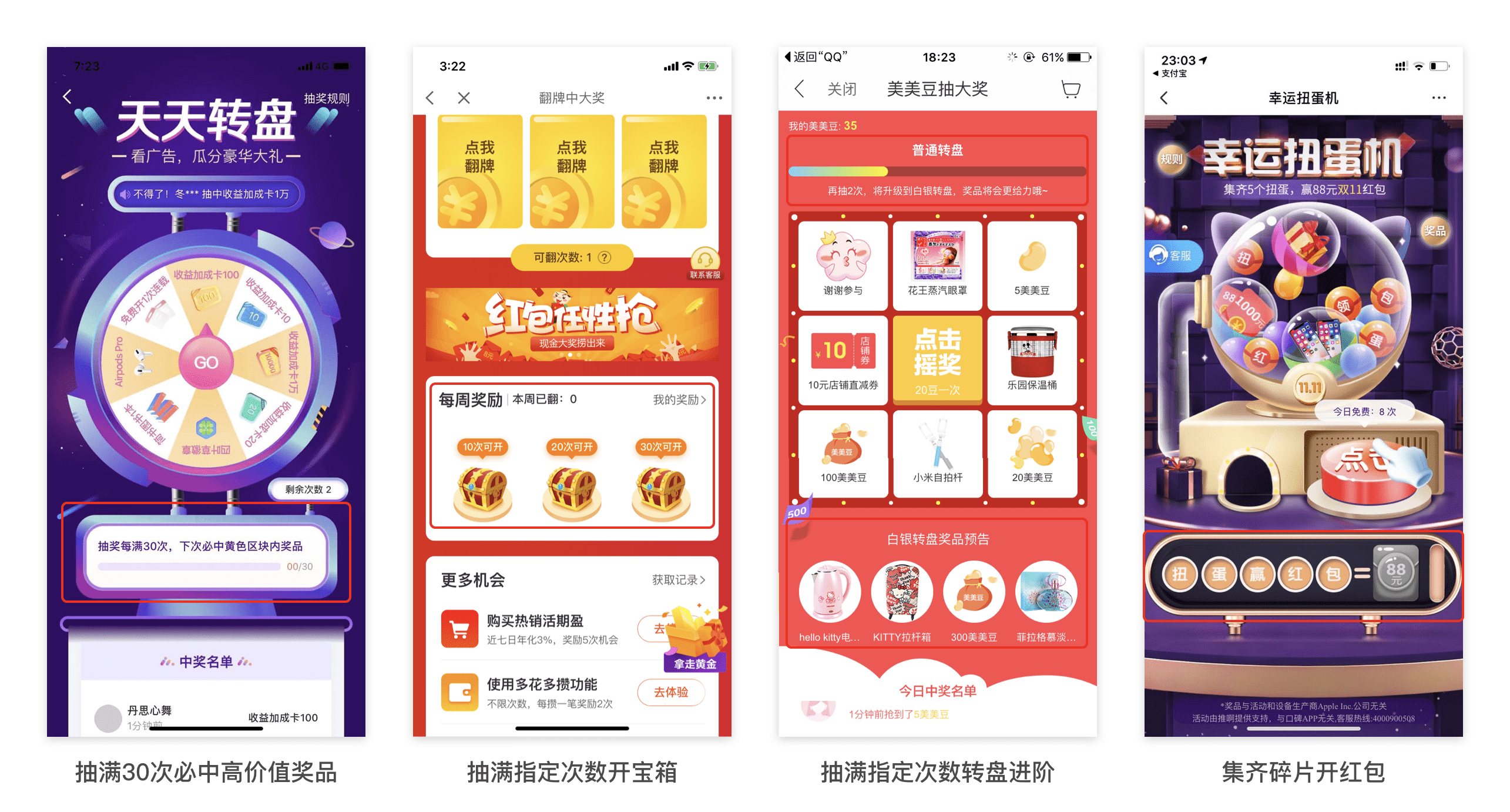
So setting a goal for the user is essential. It smoothly accommodates the shift in user motivation and triggers the goal-completion effect, driving behavior over the goal cycle. For example:
- Every 5th draw, guaranteed win from the yellow tier (higher-value prizes);
- Or 5 draws unlocks a yellow treasure chest, 9 draws unlocks a red one, 12 draws unlocks a purple one…
- Or release a fixed-quantity grand prize daily;
- Or collect fragments to win a grand prize (combining with a lottery-style mechanic)…
By adding progression rewards, you motivate continued participation. Combine these with on-screen copy, progress bars, and tooltip bubbles for effective visual communication.
2.6 Social Influence
In Design Summary of Collection-Style Campaigns, we covered how social influence matters for operational campaigns in detail — it has powerful effects on virality, gameplay expansion, and business conversion. I won’t rehash all of it; just a few design techniques worth highlighting.
2.6.1 Earn draws by inviting friends
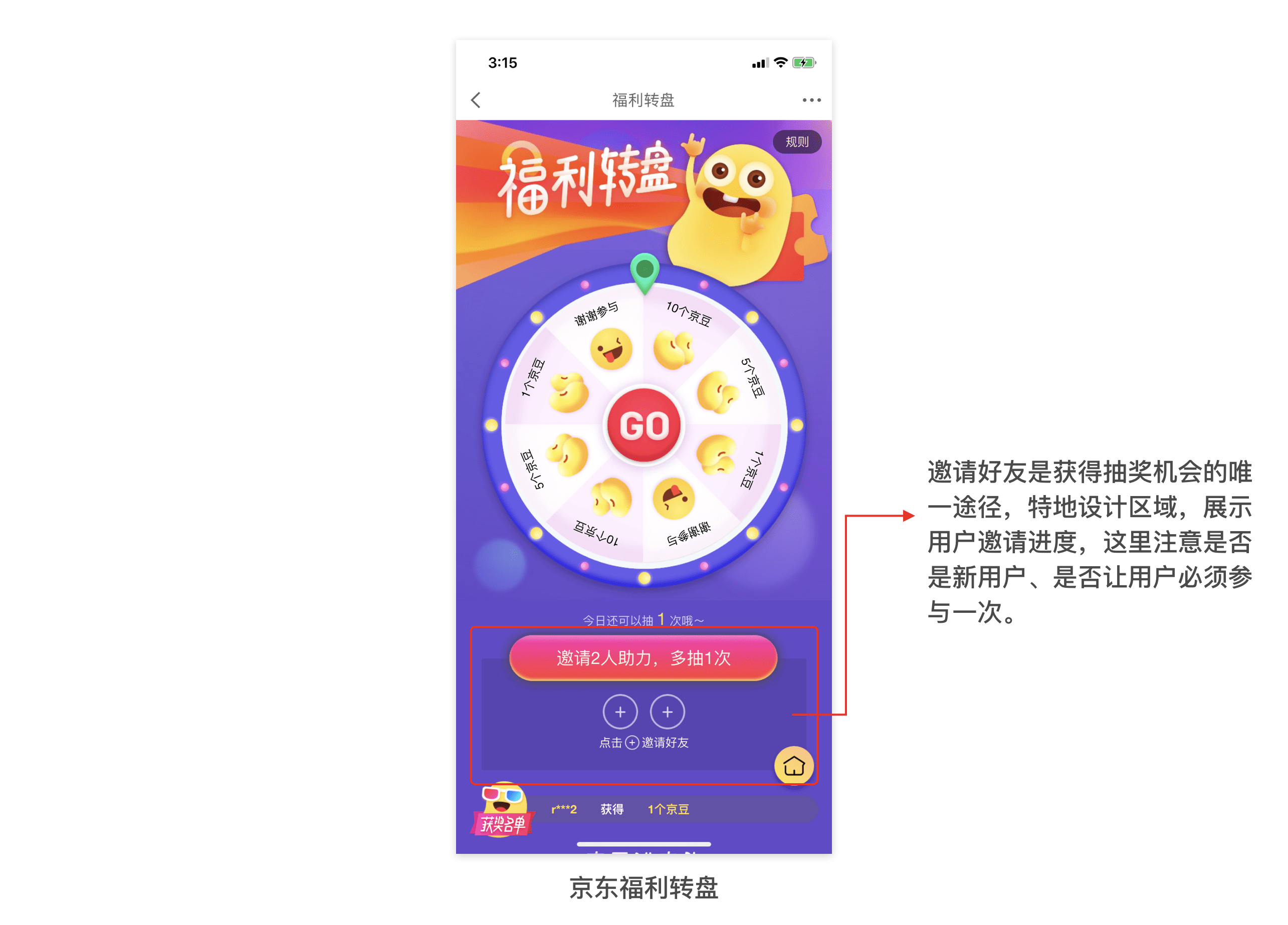
Self-explanatory: include “invite friends” as one of the ways to earn draw chances. If it makes sense, tier it — inviting more friends earns more draws. You can even add a dedicated module in the campaign UI to guide invites and track progress.
2.6.2 Guide users to share
The precondition for users to share something is that they feel the content is worth sharing — that sharing it satisfies vanity, showing off, or self-interest. If you prompt sharing when users don’t feel that way, they’ll feel insulted and mocked — and I mean that — think about how strong your resistance and disgust are when a system makes you share something you don’t want to share.
So at the right scene, the right moment, with the right asset, users have the motivation to act, and the share actually produces real business value.
Example: when a user wins a big prize, give them a beautifully designed, distinctive winning card. They’re already immersed in the excitement of winning and want to share it. Now the system’s “kindness” lands perfectly — sharing happens naturally, and that kind of share actually attracts new users.
2.6.3 Send chances and items to friends
Many games have this mechanic: users have a fixed daily quota for sending energy or coins to friends, and the user gets the same amount back. Energy gets used to participate; coins buy items.
The same mechanic can apply here — send draw chances or items to friends, and get the same amount back. Under the cover of altruism, this creates a win-win.
2.6.4 Leaderboards / scrolling winner lists / live-win feeds
These are all social-influence components. Compared to live feeds (which scroll), winner lists and leaderboards usually live in a fixed area of the campaign page or have their own dedicated page — they’re persistent and traceable.
Looking at this content triggers the user’s envy, comparison, and wishful thinking — driving action. Leaderboards also show users how to win, onboarding them into the actions they should take. When a user sees someone overtake them on the leaderboard, they get a stronger motivation boost — often overlooked.
Watch out: leaderboards easily develop head-aggregation effects — the top of the list may not change for long stretches. The user’s own rank may also be hard to surface, which can drive them away. Possible fixes: periodically reset the leaderboard; “micro-leaderboards” that only compare the user against their friends or against similar users, etc.
2.7 Loss Aversion and Escape
I covered the underlying mechanics of loss aversion and escape psychology in the post on the interactive countdown component for operational campaigns. The short version: when people think something they have (or could have had) is about to slip away, they feel an instinctive urge to prevent it.
2.7.1 Give users items first
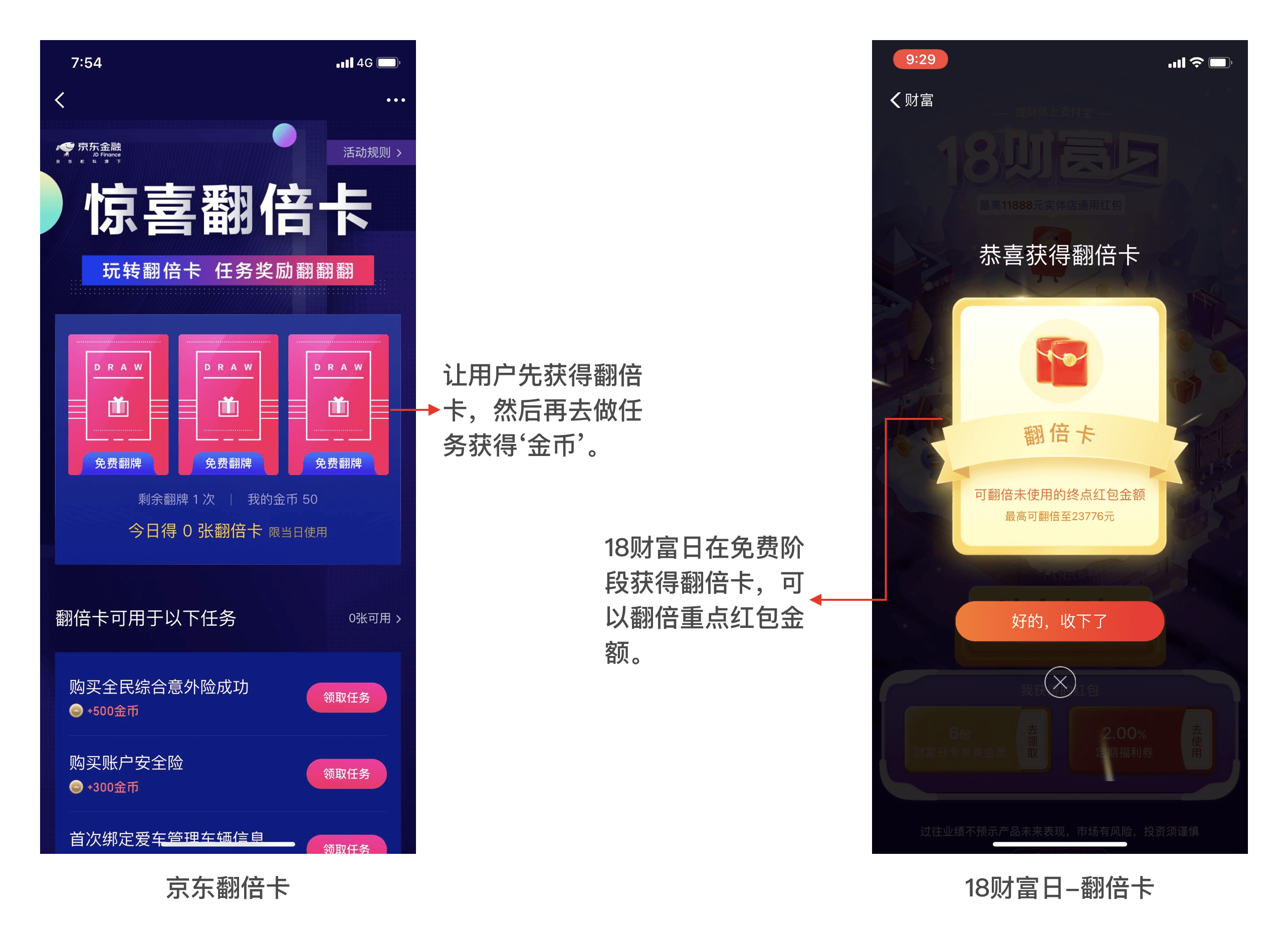
Design items whose logic is: after winning a certain prize, the item amplifies the reward. Crucially, the user has to get the item first, and only then win the reward — that ordering matters.
Items naturally have an in-built countdown — the campaign duration — and expire when the campaign ends. The user then loses the bonus the item would have provided. Designers can even set a shorter countdown on the item itself and surface it visually. Under the pull of loss aversion, the user develops a strong craving for the amplifiable reward, and acts. At this point, give them logic that increases their probability of winning that reward — otherwise, lacking a sense of control, the user feels helpless and leaves. If the user got the item during the free-trial phase, this also helps move them into the conversion phase smoothly.
How you distribute the item matters too — effectively communicate the item’s value to the user. Give it as an “honored gift” (the user feels singled out, raising the perceived value); or give it as an extra surprise after a regular draw; or include it as one of many prizes and strategically ensure the user gets it during the free phase.
Example: in the free-trial phase, the user wins a doubling card that doubles cash red-envelope rewards. The user now hustles for a red envelope, and even hustles harder to make the doubling card “count” for more.
2.7.2 Guaranteed high-value prize on consecutive draws
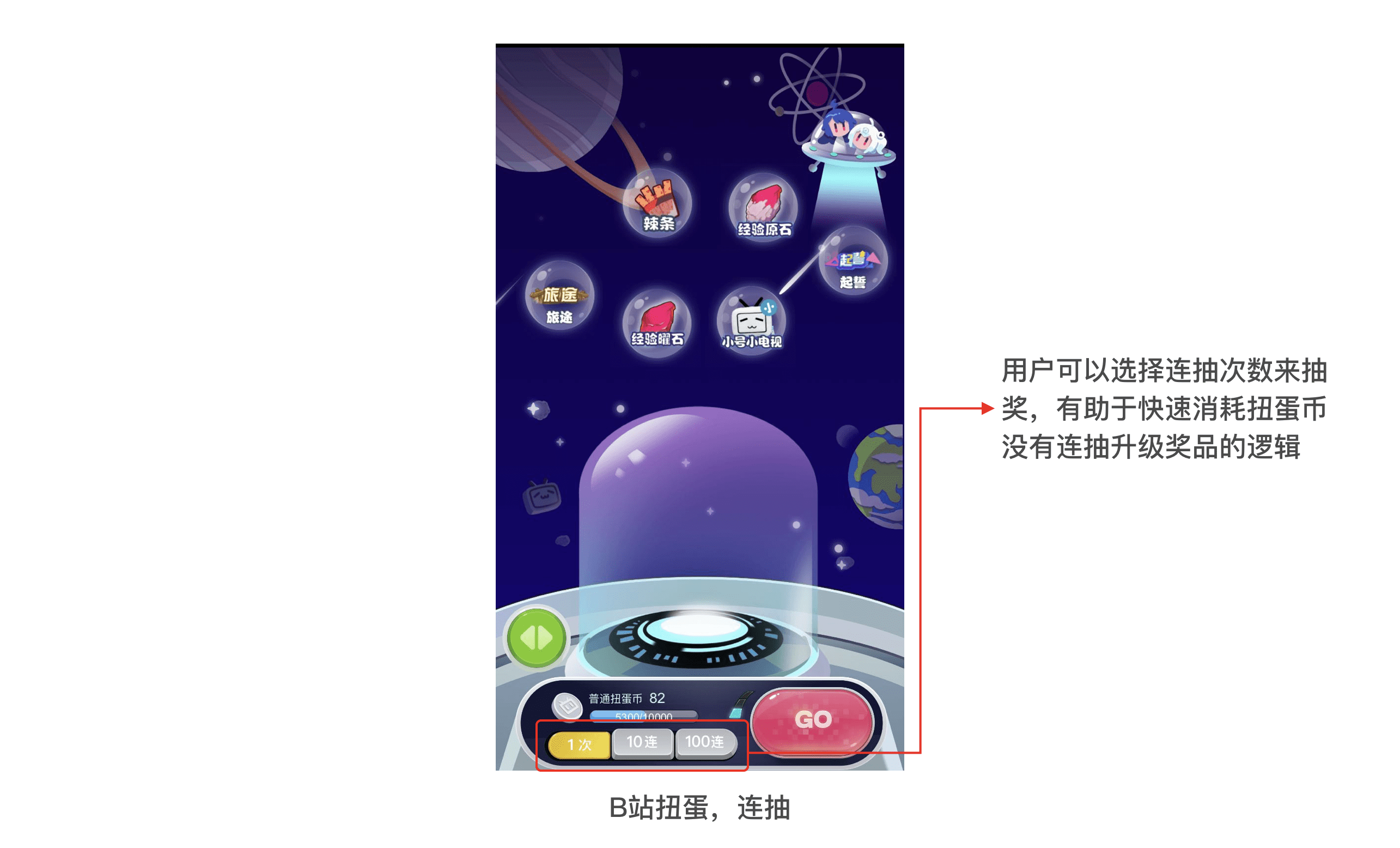
Consecutive-draw guarantees on a high-value prize encourage users to save up draw chances and trigger them in a single batch. As a gameplay technique, it lifts conversion depth significantly. Note: the consecutive-draw payoff has to match the user’s expectations, and the high-value prize has to be visually emphasized to stand out. Sometimes consecutive draws are also used purely to burn through draw chances quickly and improve operational efficiency.
Example: 5 consecutive draws guarantees a prize from the yellow tier.
2.7.3 Flexible use of countdowns
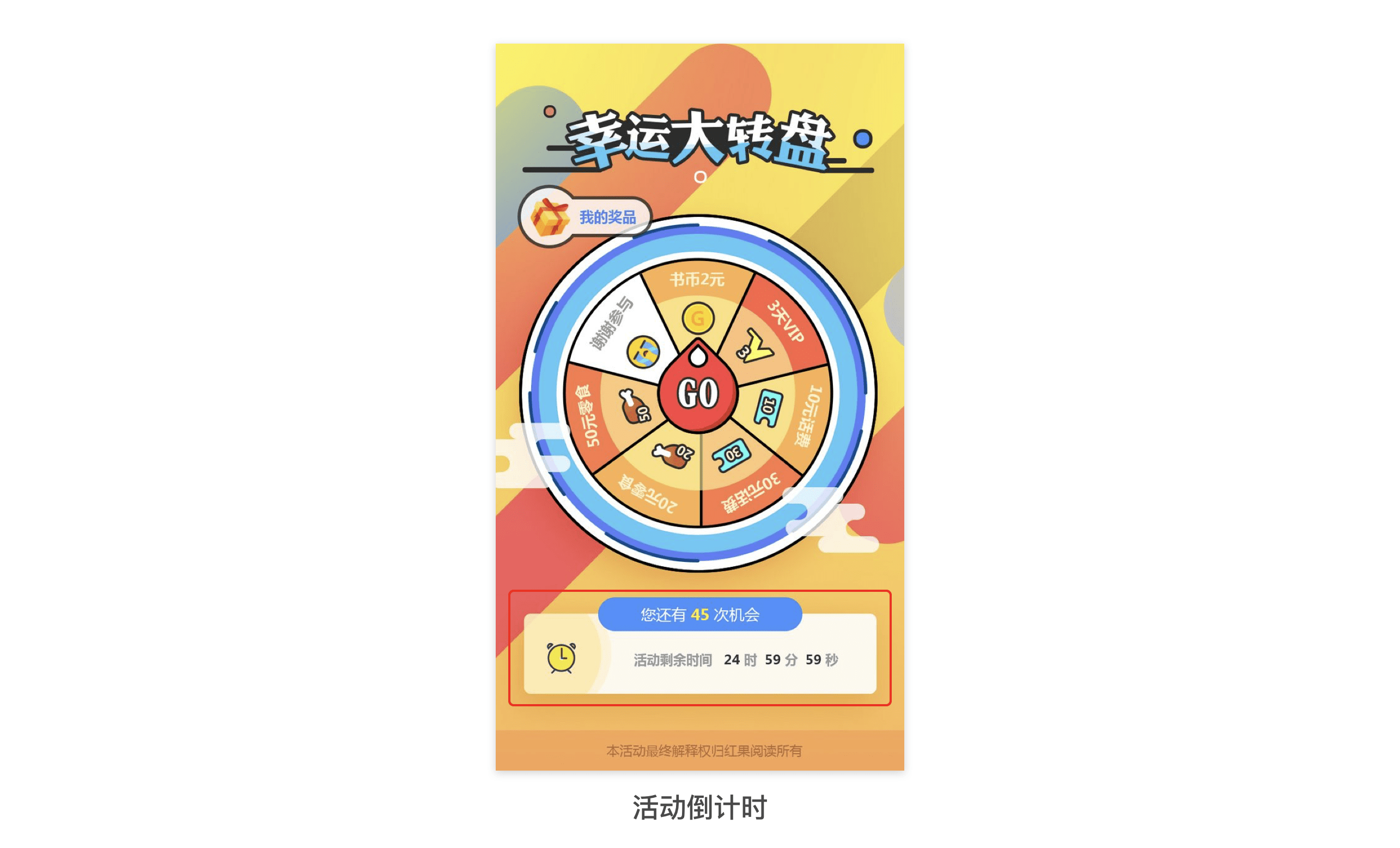
The countdown component creates scarcity through time pressure, raises user motivation, and triggers immediate action. In operational campaigns, countdowns come in two flavors — campaign countdowns and key-prize countdowns — increasing scarcity for the campaign overall and for specific high-value prizes respectively.
Be careful: when applying a countdown to a key prize, also provide a way for the user to lift their probability of winning it. If users can only keep drawing in hopes of winning, they’ll feel helpless and the countdown can backfire — to escape that feeling, users will most likely just ignore it.
2.8 User Action Cues and Re-engagement
2.8.1 The biggest possible draw button
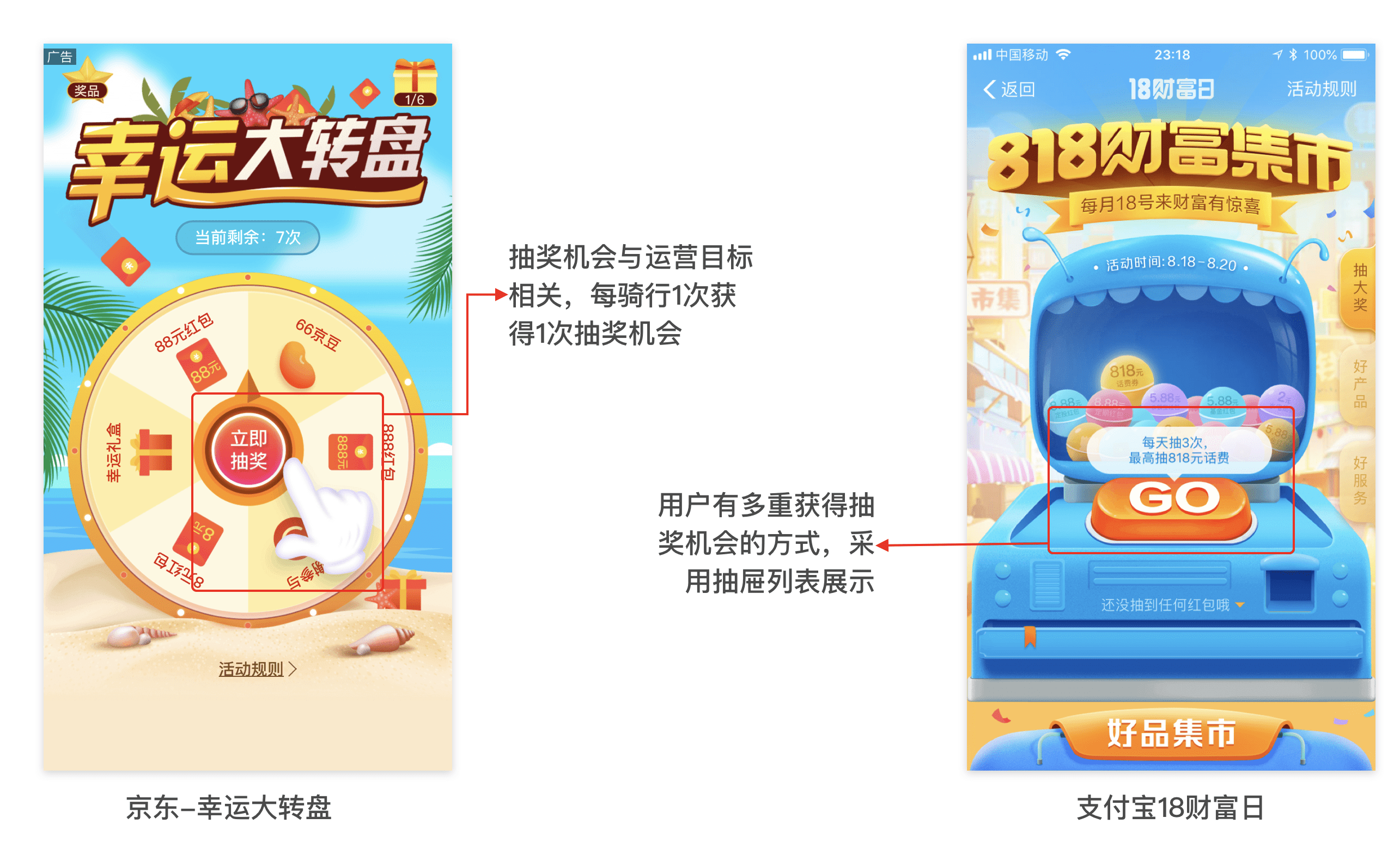
When designing, make the action button as big and flashy as possible — that’s how you grab attention and guide behavior.
Human instinct says: unless absolutely necessary, we rarely think actively; wherever there’s a cue, there’s “compliance” behavior. Effective button design gets users to “comply” with a tap, smoothly entering the campaign and participating. It also lifts user efficiency and prevents bounce on first entry due to cognitive overhead.
The “4-second rule”: if a user enters a system and can’t find what they’re looking for within 4 seconds, and the system doesn’t hint at the next step, they’ll most likely leave.
2.8.2 Popovers
The popover is an action-guidance component — typically appearing next to buttons that should be tapped or visual elements that need explaining. It’s often used together with gesture pointers to draw attention and guide behavior. Popovers can be persistent or transient. Design them strategically — define when they appear, when they hide, what they display, etc.
Example: appear when the user has been idle on the page for 3 seconds, then disappear after another 5 seconds.
I’ll cover the popover component in more depth in a future post.
2.8.3 User retention and re-engagement
User retention and re-engagement are critical but often-overlooked interaction strategies.
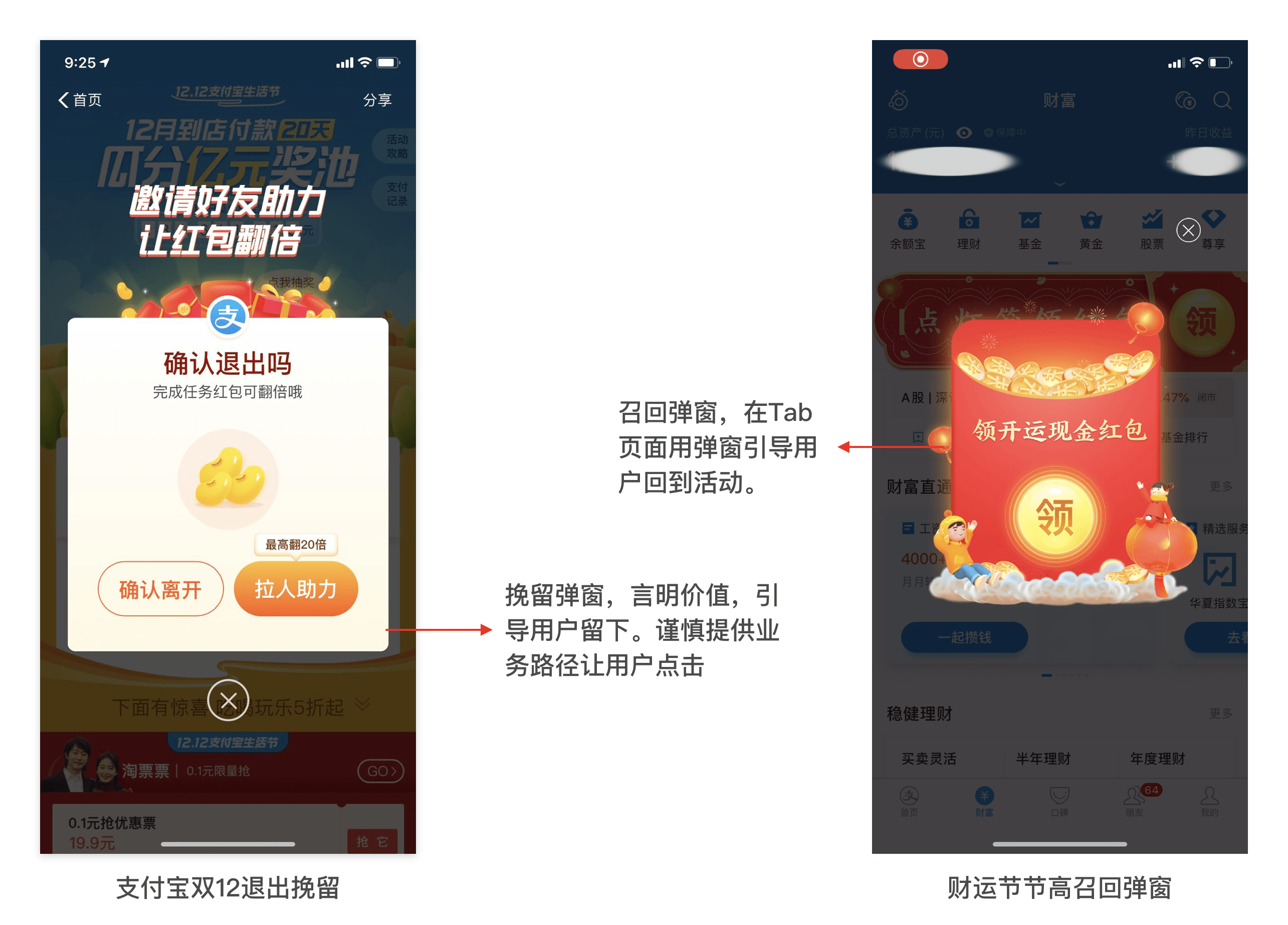
Users may enter a campaign through different channels and leave at different depths of participation. So the content used to keep them or pull them back must also be differentiated.
When designing, segment the scenarios as finely as possible, draft different modal copy for each, and use the right channels to reach the right users with precision — maximizing retention and re-engagement.
3. UI Patterns
Functional modules that may appear in a “gambling-style” campaign include: header, draw functional area, business-conversion drawer, friend-invite progress, rules section, my winnings, leaderboard, winner list, live-win feed, etc.
3.1 Scene Story and Atmosphere
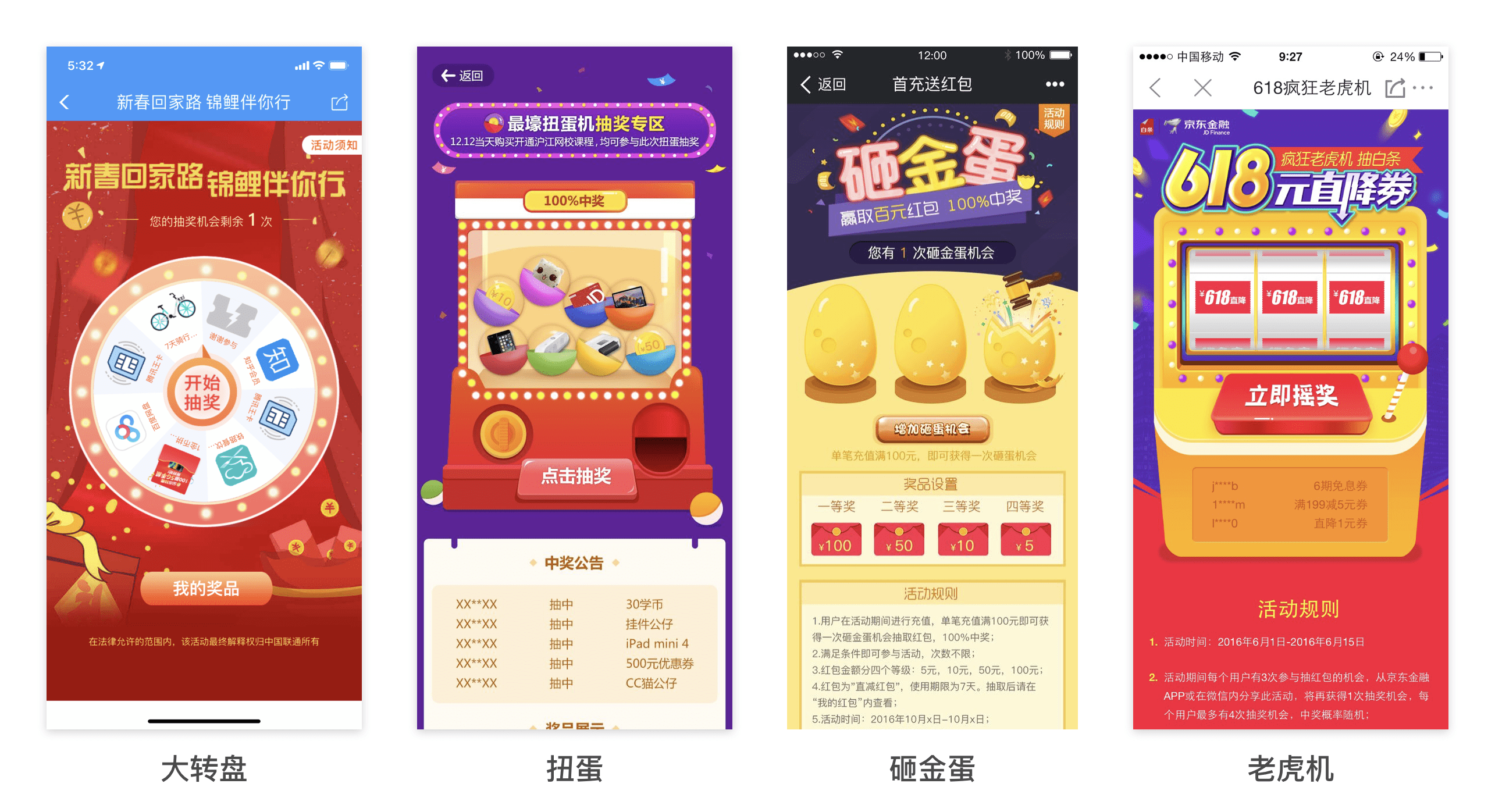
“Gambling-style” campaigns have a rich library of offline scenes to draw from — red envelopes, lottery tickets, gachapon, claw machines, slot machines, wheels of fortune, card flips, fortune cats, pinball, shell games — and you can flex these as prototypes by combining with seasonal or trending themes.
The page design should work hard to set the atmosphere — convey activity intensity and prize value effectively. Reinforce this with localized animations and background music.
3.2 Modal Design
In “gambling-style” campaigns, prize distribution, user onboarding, and re-engagement are typically delivered via modals — so modal feel matters a lot. Overlay opacity, copywriting, primary vs. secondary buttons, auto-dismiss behavior, brand onboarding elements, modal animations — all of these need careful thought. I’ll dive into this in a dedicated modal-component post later.
The bottom line: the modal’s feel must match the emotional swing you want users to experience — “stay calm for small wins; go wild for big ones!”
4. Summary
As above, “gambling-style” campaigns have a broad user base and, when operated well, are relatively easy to succeed with. When designing the interactions, focus on strategizing the rules — especially the prize-distribution logic, which should be simple, intuitive, and effective. Also, use different motivational design techniques to accommodate the shifting motivations of users during participation, maximizing the operational impact of the campaign.
Original author: @CuiYuxiong, originally published on Renrendoushichanpinjingli (woshipm.com).
Personal Annotations
- Cash red envelopes are also a form of lottery. Look at PDD’s gameplay for inspiration (mix of whole and fractional amounts, “luck-driven outcomes”).
- How do you sustain curiosity? Are there new gameplay ideas to break draw fatigue?
Cash back after purchase? Large amounts? Will that hurt conversion? Add on WeChat to claim red envelope?- Let users choose group prizes.
- Charity-based sense of mission? Ant Forest is a great example.
- Dopamine triggers: prizes displayed up front.
- When users win a big prize, give them a meaningful and well-designed winning card. They’re already in the winning mood and want to share it. But also consider the scenario — not every lottery format works for viral sharing.
- Maybe a new mechanic: roll dice, get a discount based on the points. Mixes luck and skill.
- Loss aversion: get a doubling card valid for one hour first, then get a consumption voucher. (Hand it over directly, or have them win it?)
- Win with both skill + luck (e.g., answer a question), and after showing off, the voucher doubles or they get another draw.
- List-page city-exclusive, date-exclusive perks, etc.
- Learn to manufacture holidays (whole-site events with a justification for users — why is everything so cheap? e.g., Double-11, Double-12; single-product events — “Brand X loyalty event,” “Year N anniversary,” etc.).
Comments